
June 2026 Jobs Report Shows Mixed Hiring Trends
What HR Leaders Need to Know
The June 2026 jobs report is out, and it's a mixed bag. The economy added only 57,000 jobs — about half of what experts expected, and down from 129,000 in May. At the same time, hiring in restaurants, hotels, and other hourly-heavy industries slowed down or dropped. If you hire hourly workers, this report has some useful clues about what's coming next.
Quick Takeaways
Unemployment dropped to 4.2% — mostly because fewer people are looking for work.
Wages rose .3% in June and 3.5% over the year which is still behind inflation.
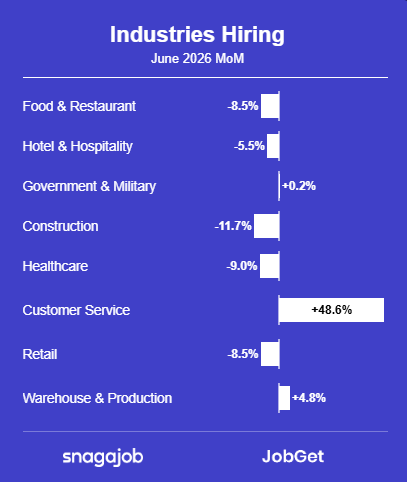
Our own job posting data fell 2.87% month over month, matching the national slowdown.
Average workweek remained at 34.3 hours in June.
Snagajob Job Posting Signals
Snagajob's June 2026 job posting activity month-over-month:
Which BLS Sectors Rose and Which Didn't
Healthcare & Social Assistance: +47,000 jobs combined
Healthcare alone added 22,000 jobs which is significant, however it's also much lower than the typical pace of +38,000 jobs. This, combined with the lower job postings seen on Snagajob, could mean healthcare hiring is slowing down faster than the official numbers show yet, or that employers are filling roles through referrals instead of new external postings.
Social assistance added 25,000 jobs - mostly in individual and family services (+17,000 jobs).
Professional & Business Services: +36,000 jobs
Construction: +11,000 jobs
Government: +8,000 jobs
Most other sectors were flat or negative.
Leisure & Hospitality: -61,000 jobs
This follows a strong hiring for hospitality in the previous month; most of this is due to seasonality with little net change in 2026. This was weaker-than-usual summer hiring given extra tourism expected from events like the World Cup.
Information: -9,000 jobs
Retail: -7,500 jobs (essentially flat)
3 Key Takeaways for Hourly Hiring Leaders
1. Wages Are Still Growing
Average hourly earnings increased 0.3% in June and are up 3.5% for the year. Production and nonsupervisory workers saw earnings rise 0.2% month-over-month. Average hourly pay for all private-sector workers was $37.64 in June. For hourly and non-supervisory workers specifically, pay rose to $32.38 an hour.
Despite these increases, wage growth has now trailed inflation for three months in a row. That means real pay — what workers can actually buy with their paycheck — isn't keeping up. For hourly employers, this raises the stakes on pay competitiveness and retention.
2. Average Workweek Declined Slightly
The average workweek for hourly and non-supervisory workers dipped slightly, from 33.8 to 33.7 hours. That can be an early sign that some employers are trimming hours before they trim jobs.
Meanwhile, the unemployment rate declined slightly to 4.2%; the lowest it's been since June 2025 when it was 4.1%
3. Fewer People Are in the Job Market
The labor force participation rate fell to 61.5% from 61.8% in May. This is the lowest it's been since March 2021. This means fewer people were in the job market at all in June, and is driving the low unemployment rate.
Long-term unemployment is rising. 1.9 million people have been out of work for 27 weeks or longer — up 286,000 from a year ago.
4.7 million people want full-time work but can only find part-time hours. This is a pool worth targeting if you're trying to fill full-time hourly shifts.
6.0 million people want a job but aren't counted as unemployed because they've stopped actively searching. Of these, 477,000 are "discouraged workers" who believe no jobs are available to them.
This represents a great opportunity for hourly hiring --especially for employers willing to focus on transferable skills rather than recent work history. These workers might respond to job posts that are easy to find and easy to apply to — even if they're not showing up in traditional job-search numbers.
What the Experts Are Saying
CNBC — "The pace of job growth is plenty strong enough to maintain a steady unemployment rate and average hourly earnings are solid, but not accelerating."
NBC News — "Overall, we view the broad mosaic of jobs data as consistent with labor-market stabilization from weakness in late 2025"
NPR — "We aren't necessarily seeing a sharp deterioration that would raise alarm bells, but we're also stuck a little bit. We're not really seeing that reacceleration that I think would get workers really excited about the current job market.
Robert Half — "A cooler labor market doesn't eliminate retention risk or make qualified candidates easier to find."
What This Means for Your Hiring Plans
Don't assume a slow jobs report makes hiring easier. Fewer people are actively job-hunting, even though more people are technically without work. Categories like Customer Service and Warehouse & Production are still competitive to hire for, based on our posting data.
Watch real-time posting trends, not just government data. Official numbers take weeks to update. Our own data on transportation, healthcare, and hospitality is already moving faster than the national report — treat it as an early signal for your industry.
Pay competitiveness matters more right now. With wage growth behind inflation for three months straight, hourly workers are more likely to leave for better pay. Small, timely raises could pay off in retention.
Look at underused talent pools. With 4.7 million people stuck in part-time work and nearly half a million discouraged workers sitting on the sidelines, easier-to-find and easier-to-apply-to job posts could reach candidates who've stopped actively searching.
As the hourly expert, we're here to help with your hiring needs. Contact our team today to learn more about our solutions for enterprise, mid-size, and small businesses.
Sources
U.S. Bureau of Labor Statistics, The Employment Situation — June 2026 jobs report
Snagajob by JobGet internal job posting data, June 2026
 Your Privacy Choices